
Steel silo, is a storage container constructed with steel plate as the main material. With the progress of science and technology, grain storage technology is also developing. Grain silo paddy storage silo as a new type of grain storage, because of its high efficiency, safety, environmental protection characteristics, gradually received widespread attention.
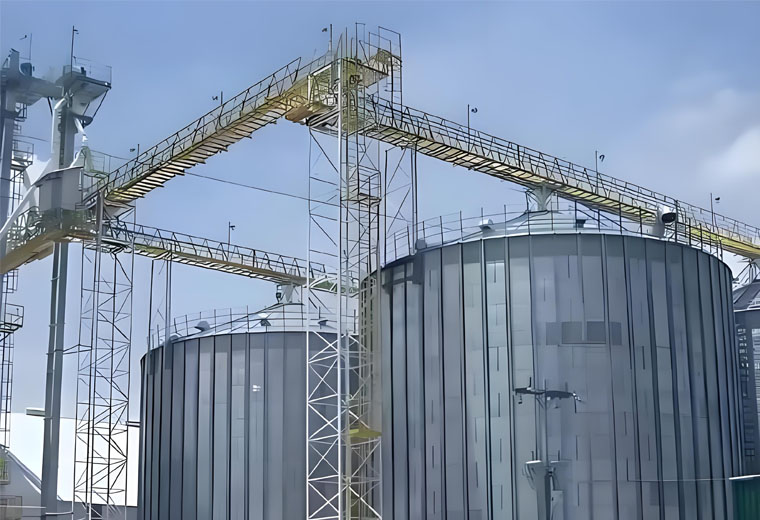
Technical and Economic Advantages of Steel Grain Silos
1. Structural Integrity and Materials Science
Steel silos are manufactured using high-strength galvanized or corrugated steel sheets and typically feature bolted or welded structures. This design enables them to effectively withstand external forces, including earthquakes and strong winds, while ensuring zero water leakage. Compared to concrete grain silos, steel structures offer a higher strength-to-weight ratio, allowing for the construction of taller, more space-efficient silos. The use of food-grade anti-corrosion coatings further prevents rust contamination, thereby extending the shelf life of grain.
2. Advanced Microenvironment Control
The core advantage of modern grain silos lies in their precise environmental management:
- Airtight Sealing and Controlled Atmosphere (CA): Grain silos can be equipped with airtight sealing systems to support controlled atmosphere storage (low oxygen or high carbon dioxide), effectively suppressing insect respiration and mold growth without the need for chemical fumigation.
- Integrated Ventilation Systems: Perforated floor ducts or central screw conveyors enable forced ventilation, thereby regulating temperature and humidity gradients. This prevents the formation of “hot spots” and condensation—which is critical for rice, as uneven drying can easily cause the grains to crack.
- Smart IoT Monitoring: Many modern grain silos incorporate wireless sensors that track temperature, humidity, and carbon dioxide levels in real time, enabling data-driven decision-making and early warnings.
3. Pest and Mycotoxin Management
Traditional storage methods are frequently plagued by weevils, moths, and aflatoxin contamination. Steel silos minimize entry points for pests and, combined with sealing measures, naturally suppress pest proliferation by isolating oxygen. Additionally, smooth interior walls reduce dust accumulation and facilitate cleaning between batches, significantly lowering the risk of cross-contamination—which is critical for export-grade rice.
4. Economic Viability and Scalable Investment
Cost-effectiveness is a decisive factor for users choosing steel silos. The market offers tiered pricing structures to meet varying capacity needs:
- Small-scale units (15–25 tons): Priced between $150,000 and $250,000, these are ideal for family farms and cooperatives.
- Medium-sized complete systems (50–metric tons): Priced between $250,000 and $1 million, these are suitable for rice mills and regional collection centers.
- Large industrial silos (500+ tons): Priced between $1 million and $1.5 million, these are designed specifically for national reserve warehouses and large-scale farms.
Despite the higher upfront investment, steel silos offer a rapid return on investment by reducing losses (typically lowering the loss rate from 8–10% to below 1–2%), lowering labor costs (through automated loading and unloading), and extending storage time (with proper management, rice can be stored for 2–3 years).
5. Sustainability and Green Agriculture
Steel is 100% recyclable, aligning with the principles of a circular economy. Silos have a service life of 20–30 years, and at the end of their lifespan, over 90% of the materials can be reused, thereby reducing construction waste. Additionally, steel silos have a small footprint, minimizing land use—which is critical in agriculturally intensive areas. Modern ventilation fans and solar-powered drying systems further reduce energy consumption, supporting carbon-neutral grain storage initiatives.
6. Rapid Construction and Modular Flexibility
Unlike cast-in-place concrete, steel silos are prefabricated off-site and assembled on-site, shortening the construction cycle by 50% to 70%. This modular design facilitates future expansion—allowing additional silos to be added without disrupting existing operations. Mobile screw conveyor systems and belt conveyors can be easily reconfigured, providing logistical flexibility during seasonal harvest peaks.
7. Comparative Advantage Over Traditional Storage
- Wooden barns: Susceptible to rot, termites, and fire; poor sealing.
- Masonry bins: Heavy, slow to build, prone to cracking and moisture seepage.
- Steel silos: Uniform airflow, rodent-proof, low maintenance, and compatible with automated weighing and sampling systems.
In summary, thanks to their combined advantages of efficiency, safety, cost-effectiveness, and environmental friendliness, steel grain silos are gradually becoming the mainstream choice for modern grain storage. With the integration of AI-driven grain condition forecasting, robotic grain cleaning, and blockchain-based traceability technologies, grain silos are evolving into “smart storage centers.” With falling manufacturing costs and increased government subsidies for post-harvest infrastructure, the adoption rate of grain silos in Asia, Africa, and Latin America is projected to grow at a compound annual growth rate (CAGR) exceeding 6% by 2030. For rice-producing countries, investing in grain silo technology is no longer an option but a strategic imperative to ensure food security and export competitiveness.